Commercial water attenuation systems are fundamental for controlling surface water run-off in modern property developments across towns and cities in the UK. Installing these underground stormwater storage solutions involves significant capital investment, driven by various site variables and complex design decisions. This comprehensive guide breaks down the primary cost drivers that influence overall expenditure, ranging from initial ground preparation and trenching to system selection and long-term maintenance.
We examine how civil engineering choices, local planning mandates, and physical site accessibility directly affect commercial project budgets. Readers will gain clear insights into excavation requirements, structural load considerations, pipework integration, and the financial impact of selecting modular geocellular crates versus concrete tanks. By understanding these technical variables early in the planning stage, developers, commercial landlords, and site managers can accurately forecast capital outlay, mitigate financial risks, and optimise stormwater management infrastructure for 60-year operational lifespans.
Unforeseen subterranean challenges frequently disrupt commercial property developments across the UK, turning routine groundworks into complex civil engineering hurdles. Without completing a comprehensive geotechnical investigation prior to breaking ground, unpredictable earth conditions can drastically alter the required excavation depth and destabilise primary construction timelines.
Encountering a High Water Table or poor Soil Bearing Capacity during site trenching often causes severe side-wall collapses, leading to immediate site stoppages and expensive remediation works. Industry data shows that unmapped ground conditions cause up to 35% of all civil engineering budget overruns on UK commercial sites.
Early soil testing combined with lightweight modular attenuation systems allows structural engineers to design tailored foundations that minimise bulk earth removal and eliminate unnecessary waste. Modern trench shoring and targeted site preparation techniques stabilise vulnerable ground quickly, protecting project margins and keeping overall construction schedules strictly on track.
KEY TAKEAWAYS
- Comprehensive soil assessment prevents expensive budget variations by identifying groundwater levels and load limitations long before excavation machinery arrives on site.
- Controlling dig dimensions through precise structural engineering directly reduces muck-away expenses, off-site haulage fees, and imported aggregate fill requirements.
- Choosing lightweight modular crates reduces the reliance on heavy plant machinery when navigating unstable ground, lowering total installation costs by up to 20% overall.
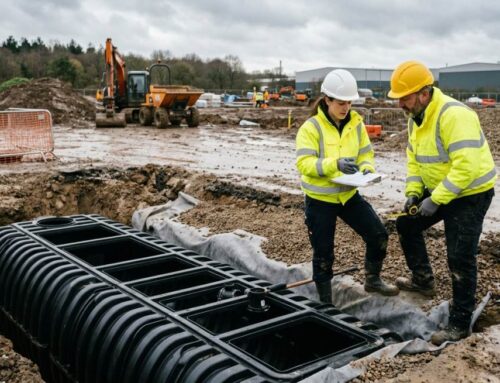
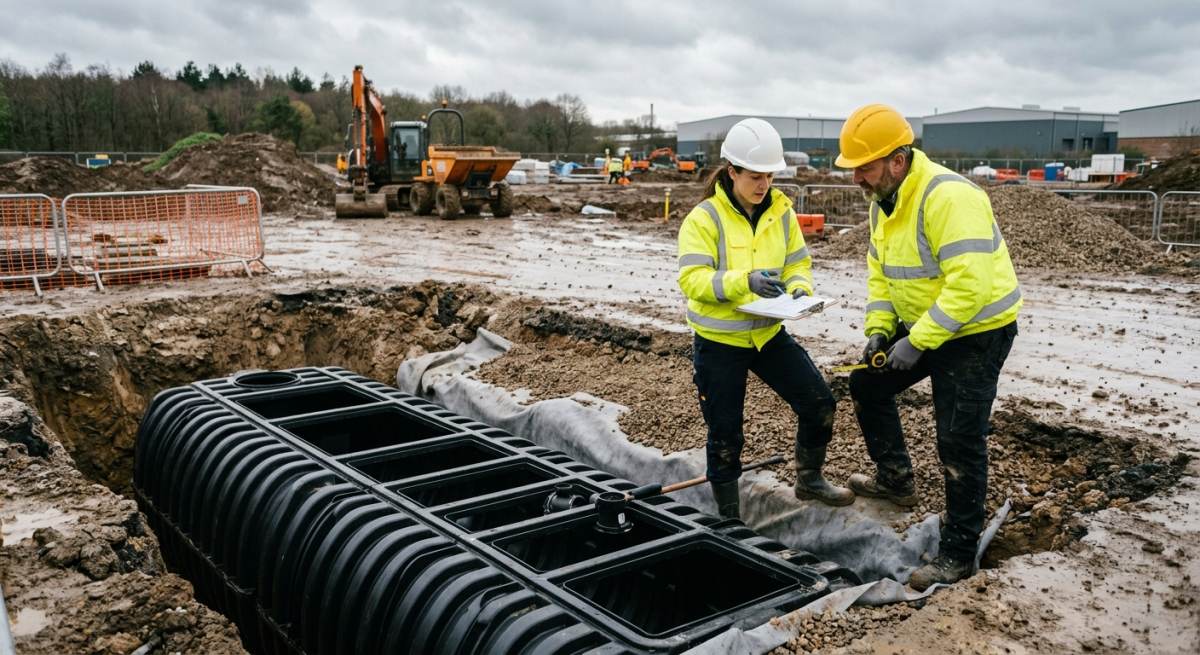
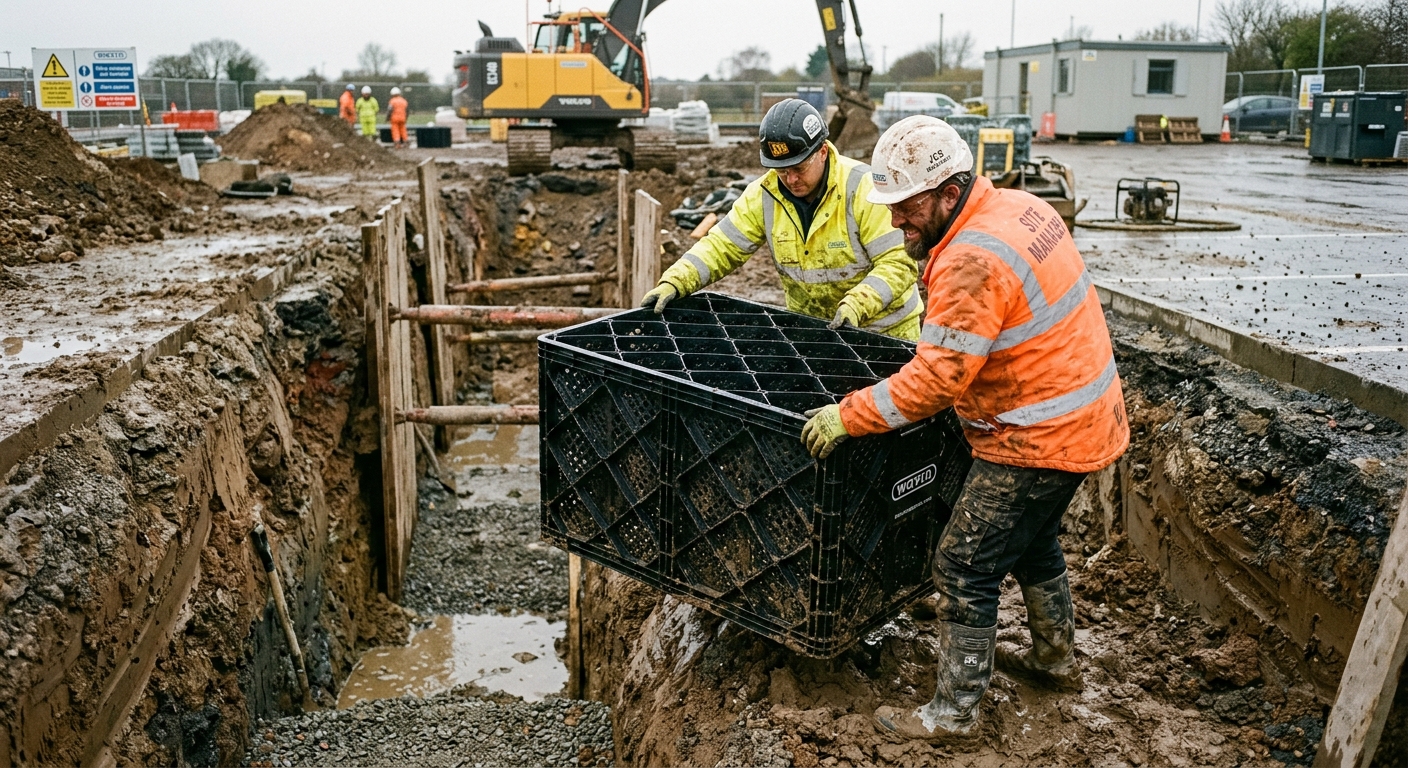
Engineers verify the structural layout of underground modular attenuation crates to ensure efficient stormwater management compliance.
Table of Contents
- Structural Material Selection and System Unit Costs
- Flow Control Devices and Upstream Silt Management
- Impermeable Membrane Encapsulation and Gas Protection Layers
- Specialist Onsite Installation and Labour Overhead
- Long-Term Access Provisions and Inspection Channels
- Frequently Asked Questions around Water Attenuation
Need specialist advice on water attenuation?
Speak to our technical team today for tailored specifications, regulations compliance, and practical support.
Structural Material Selection and System Unit Costs
Capital Expenditure Variances Across Primary Material Types
Material choice directly establishes the base unit price per cubic metre of stormwater storage capacity on commercial developments. Lightweight plastic units offer the lowest initial supply cost, whereas heavy structural options command a higher procurement price.
Specifying Geocellular Crates typically delivers the lowest initial unit cost, averaging between £35 and £65 per cubic metre of storage volume. These modular units are lightweight, making transport to local streets or tight town sites inexpensive and simple to manage. By comparison, precast concrete attenuation systems cost between £140 and £220 per cubic metre for supply.
Concrete demands heavy freight and specialised crane hire, but it provides immediate structural strength with a 100-year operational lifespan. Corrugated Steel Storage sits between these options at roughly £90 to £150 per cubic metre, providing a durable, flexible underground tank layout that suits medium-density commercial sites across built-up areas.
Structural Capability and Vertical Loading Requirements
Selecting a system with the correct vertical loading class prevents structural failure beneath heavily trafficked zones like logistics parks or delivery hubs. Matching storage unit strength to expected surface loads prevents collapse without inflating material budgets through unnecessary over-engineering.
Shallow installations under active roadways or heavy goods vehicle access lanes require high structural resistance. Standard Geocellular Crates installed in light-traffic car parks handle basic surface loads, but heavily trafficked commercial yards require specialist high-strength plastic modules or reinforced concrete units. Placing flexible plastic crates under high dynamic wheel loads requires deep cover depths, often exceeding 1 to 2 metres of engineered fill. This additional earthworks requirement increases excavation volumes, muck-away disposal fees, and imported backfill costs. Precast Concrete Attenuation handles extreme wheel loads at shallow cover depths under 0.5 metres, significantly reducing overall excavation expenses despite its higher upfront unit price.
Material Selection and Evaluation Framework
Engineers must evaluate ground conditions and surface traffic requirements before signing off on storage material specifications. Following a structured assessment framework reduces installation delays and avoids costly structural remediation later in the project life. Taking time to review these structural variables ensures the chosen system meets regulatory requirements without exceeding initial capital budgets.
- Determine peak dynamic wheel loads and establish the exact vertical loading class required for surface operations across the site.
- Assess local groundwater tables and soil-bearing metrics to eliminate buoyant or structurally unsuitable underground materials.
- Calculate overall installed expenditure by balancing raw material unit prices against excavation depth, craneage fees, and surrounding aggregate volumes.
| Specification | Primary Features | Lifespan | Cost Bracket | Compliance |
|---|---|---|---|---|
| Standard Polypropylene Geocellular Crates | High void ratio up to 95 percent, rapid manual assembly, lightweight construction suitable for soft landscaping and pedestrian zones | 50+ years | £ | CIRIA C739, BBA Certified, Building Regulations Part H3 |
| Heavy-Duty Structural Geocellular Crates | Vertical load strength up to 700 kN/m2, engineered for HGV load propagation, deep burial capabilities, integrated access channels | 50+ years | ££ | CIRIA C739, BBA Certified, Building Regulations Part H3 |
| Large Diameter Corrugated HDPE Pipe System | Structural ring stiffness SN8, smooth internal bore for high velocity flow, excellent dynamic traffic load resistance, flexible layout options | 60+ years | £££ | BS EN 13476, Design and Construction Guidance, Building Regulations Part H3 |
| Precast Concrete Box Culvert Tank | Extreme structural integrity, inherent resistance to floatation in high groundwater conditions, heavy loading capabilities, low long-term maintenance | 100+ years | ££££ | BS EN 14844, BS 9295, CIRIA C753, Building Regulations Part H3 |
Flow Control Devices and Upstream Silt Management
Flow Control Selection Impacting Capital Expenditure
Hydrobrake Vortex Control units and penstocks directly dictate the hydraulic efficiency and initial purchase cost of attenuation infrastructure. Selecting self-activating vortex valves reduces the required storage volume by up to 30% compared to traditional orifice plates, lowering overall excavation costs across built-up areas.
Capital expenditure varies significantly depending on the chosen unit mechanics. Simple orifice plates present a low initial outlay of around £500, yet they risk frequent blockages and require larger attenuation footprints. Advanced Hydrobrake Vortex Control devices cost between £2,000 and £8,000 depending on flow rates, but their unique hydraulics optimise discharge rates into town sewers. Incorporating heavy-duty Penstocks adds an additional £1,500 to £6,000 per chamber, supplying isolated flow control during chemical spills or maintenance work on local streets. Heavy concrete access manholes with reinforced covers add a further £2,500 to £5,000 per installation depth of 3 metres.
Upstream Silt Protection Mitigating Maintenance Costs
Installing dedicated silt traps and catchpits before the main tank prevents sediment build-up that permanently reduces storage capacity. Effective upstream management cuts long-term maintenance expenses by 60% and protects downstream watercourses from heavy silt contamination.
Without robust pre-treatment, fine soils and washed-out aggregates settle directly inside modular geocellular crates or concrete tanks. Removing sediment from inside an installed attenuation tank requires expensive specialist jetting that can cost over £3,000 per intervention. Prefabricated concrete or plastic catchpits capture heavy particles before entry, while advanced Silt Traps strip out fine suspended solids and hydrocarbons. Integrating 2 or 3 strategic catch points adds approximately 10% to 15% to total civil engineering installation fees, yet it secures system performance for a 60-year lifespan and prevents catastrophic structural blockages.
Standardised Maintenance Sequence for System Longevity
Establishing a structured maintenance sequence prevents sudden hydraulic failures and keeps drainage channels clear throughout the year. Following a strict routine protects financial assets and reduces emergency call-out charges across commercial sites.
- Inspect catchpits and silt traps every 6 months to measure sediment depth and check for blockages.
- Vacuum out collected debris using a suction tanker once silt accumulates past 300 mm depth.
- Exercise manual Penstocks every 12 months to confirm smooth mechanical operation and watertight sealing.
Regular servicing ensures that high-volume storm events do not overwhelm the site or cause surface flooding on local streets. Contractors typically charge between £400 and £800 per maintenance visit, making planned servicing far cheaper than repairing damaged pipework or replacing compromised geocellular structures.
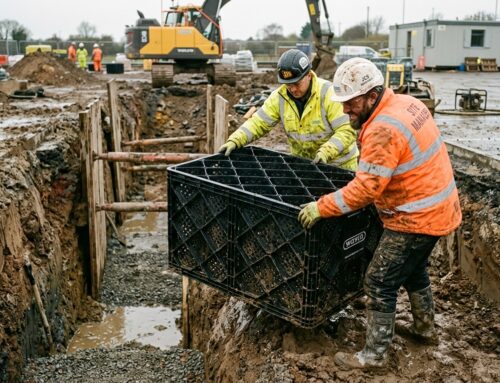
Complex ground conditions and specialised machinery installation significantly influence overall attenuation system costs.
Impermeable Membrane Encapsulation and Gas Protection Layers
Material Selection and Specification Requirements
Specifying the correct lining system directly dictates material supply costs and specialised site labour needs. Selecting a heavy-duty Polypropylene Liner alongside a specialised Hydrocarbon Barrier ensures long-term structural integrity while significantly increasing upfront capital expenditure.
Ground conditions in a dense town or brownfield site often demand complex multi-layer encapsulation to prevent hazardous soil gases or chemical run-off from entering the drainage structure. While a standard 1 mm polypropylene liner provides cost-effective containment for clean greenfield developments, contaminated sites require advanced composite systems. Adding a dedicated hydrocarbon barrier increases material expenses by 35% to 50% per square metre, but it remains essential for compliance with local water authority regulations. Design engineers must balance initial material outlays against site-specific risk profiles to prevent expensive retrofits or environmental fines.
Quality Assurance and Joint Testing Protocols
Rigorous joint testing protocols ensure the sealed attenuation tank remains entirely watertight and gas-proof throughout its 60-year service life. On-site double-seam welding combined with non-destructive air pressure testing adds labour hours but prevents catastrophic post-backfill failure.
Achieving a continuous seal across a welded geomembrane requires certified technician teams and strict quality control on site. To verify seam integrity before backfilling, installers follow a rigid 3-step validation procedure:
- Perform continuous dual-hot-wedge thermal welding along all panel overlaps to create a sealed central air channel.
- Insert a needle pump into the sealed channel and pressurise the joint to 2 bar for 5 minutes.
- Monitor pressure gauges to confirm 0% pressure drop, signing off the seam prior to burial.
This thorough testing framework increases installation timelines by roughly 15%, but it eliminates the risk of hidden leaks that could compromise surrounding building foundations.
Substrate Cushioning and Protection Mechanics
Adequate substrate preparation and puncture resistance layers prevent sharp aggregate from breaching the primary impermeable membrane. Installing a heavy protection geotextile above and below the tank envelope reduces leak risks and avoids expensive remedial excavation works.
Geocellular attenuation crates exert heavy point loads onto base materials when fully loaded with stormwater. Without adequate cushioning, sharp gravel backfill or rough sub-bases can puncture membrane envelopes during compaction. Using a high-density Protection Geotextile with a minimum weight of 300 grams per square metre absorbs these mechanical stresses. Allocating 5% to 8% of the total installation budget to top and bottom protective geotextiles prevents tear failures, ensuring the primary liner delivers an uncompromised 50-year service life in demanding built-up areas.
Specialist Onsite Installation and Labour Overhead
Certified Installers and Labour Rates
Engaging certified installers ensures that attenuation systems comply with stringent UK water management standards while avoiding costly rework. Specialist groundworks teams charge premium daily rates that directly inflate the baseline civil engineering budget.
Deploying standard civil contractors for complex attenuation tanks often leads to errors that compromise long-term performance. Specialist tradespeople carry valid accreditations for confined space entry, deep excavation safety, and structural drainage installation. Labour costs in a busy city or built-up area reflect these qualification levels, with skilled operative rates routinely exceeding standard site labour by 30% to 40%. Correctly sizing the workforce prevents site delays, as a typical commercial installation requires a core team of 4 to 6 skilled workers over a 2 to 3 week window.
Heavy Machinery and Plant Hire Expenses
Operational costs scale rapidly when projects require heavy excavators, trench shoring, and dedicated site craneage to manage modular crates or large tanks. These plant hire expenses represent a major portion of the overall site expenditure during early-phase civil works.
Positioning heavy stormwater storage units beneath local streets or commercial basements demands high-capacity lifting equipment. Hiring 50-tonne mobile cranes and 30-tonne tracked excavators adds £3,000 to £5,000 to weekly operational outgoings. Ground conditions also dictate whether standard trench support or heavy sheet piling is required, directly affecting machinery standing time.
To maintain safety and control budget overruns during tank placement, site teams follow a precise 3-step installation sequence.
- Mobilise specialised Site Craneage and establish stable outrigger mats over tested ground. 2. Lower pre-assembled attenuation units or concrete chambers into the excavated void using certified lifting slings. 3. Backfill around the perimeter in 300 mm compacted layers using crushed aggregate while monitoring unit alignment.
Specialist Geomembrane Welding and Sealing
Impermeable attenuation tanks rely on meticulous geomembrane welding to prevent structural leaks and surrounding soil contamination. Technicians must conduct rigorous non-destructive testing on every joint, which adds both skilled labour hours and quality assurance costs to the project.
Sealing a geocellular tank requires specialist lining subcontractors who deploy thermal double-wedge welders to join heavy-duty impermeability barriers. High groundwater tables in a town or coastal setting make robust seals essential, as groundwater ingress reduces storage capacity by 15% to 25%. Technicians charge daily specialist call-out fees alongside material charges for 1.5 mm thick HDPE or polypropylene membranes. Air lance testing and vacuum box checks on every seam add approximately 1 to 2 days of specialist site labour, but this process guarantees that the installation satisfies strict local authority approvals.
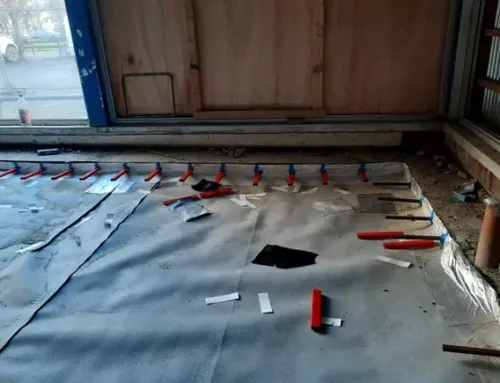
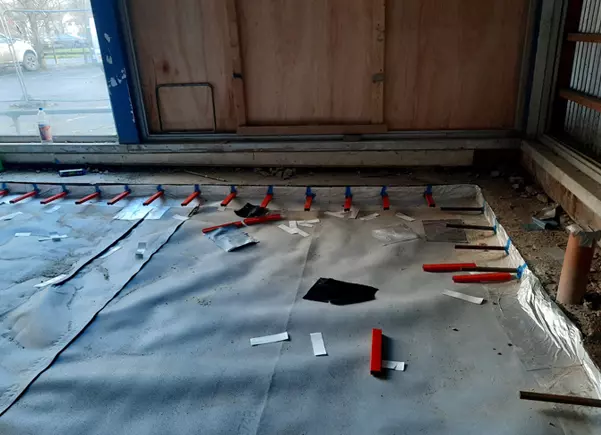
Material selection, such as heavy-duty geotextiles and membranes, plays a critical role in system longevity and overall expense.
Long-Term Access Provisions and Inspection Channels
Specifying Heavy-Duty Inspection Shafts
Integrating dedicated inspection Shafts into modular crate or tank systems increase upfront capital expenditure by 15% to 25%, depending on depth and load ratings. Specifying high-specification access points avoids costly surface excavations during the 50-year design life of the commercial asset.
In commercial projects across a busy city centre or built-up area, attenuation tanks often sit beneath car parks or delivery bays. Sub-base depth and traffic loading dictate whether plastic, concrete, or composite risers are suitable, with heavy D400 load-rated covers adding £300 to £600 per entry location. Site teams follow a standard 3-step sequence to install these vertical shafts correctly.
- Excavate the tank footprint and bed the base units on a 150 mm aggregate layer.
- Position pre-formed structural manifold units directly under the shaft entry points.
- Fit vertical riser pipes with flexible seal boots before backfilling with granular material.
Provision of Camera Access Channels
Installing continuous camera access channels throughout an attenuation matrix adds roughly £10 to £18 per square metre to the installation budget. This internal access allows CCTV survey tractors to navigate silt traps and geocellular matrices without snagging on internal structural pillars.
Local water authorities and planning officers regularly inspect these runs before signing off on SuDS adoption schemes. Omitting clear runs forces maintenance crews to deploy micro-cameras which cannot clear long distances, driving up ongoing monitoring fees. Building full-bore Camera Access Channels from day 1 allows standard 100 mm and 150 mm crawler cameras to survey up to 50 metres in a single pass. This reduces routine survey times from 4 hours down to 45 minutes, saving thousands of pounds across 10-year inspection cycles.
Integrating Suction Points and Maintenance Plans
Setting up dedicated suction points alongside a structured SuDS maintenance plan reduces long-term operational costs by up to 40% over 30 years. Silt removal vacuum tankers require clear, unhindered draw-down points to prevent heavy sediment build-up from choking structural storage volumes.
Planners and site owners must recognise that attenuation systems inevitably trap fine sands, debris, and grey silt carried from local streets. Positioned at the lowest point of the tank array, deep sump units collect these washed-in solids for quick extraction.
Connecting these sumps directly to surface-level suction points lets maintenance contractors clear 5,000 litres of slurry in less than 30 minutes without entering the tank. Incorporating these physical provisions into initial groundworks adds 3% to 5% to the total civil engineering budget, but it prevents early structural clogging, protects hydraulic capacity, and fulfils the SuDS Maintenance Plan.
Frequently Asked Questions around Water Attenuation
What Is Water Attenuation In Commercial Development?
Water attenuation is the process of storing excess surface water run-off during heavy rainfall and releasing it slowly into the drainage network. This controlled release prevents local sewer systems from becoming overwhelmed, which reduces the risk of flooding in the surrounding local area.
In commercial projects, this usually involves underground geocellular crates, concrete tanks, or large pipe systems connected to flow control devices. These systems collect water from roofs, roads, and car parks before releasing it at a safe rate.
Why Is Water Attenuation Necessary For Commercial Properties?
Water attenuation is necessary because planning regulations in England, Wales, and Scotland require commercial sites to manage surface water run-off safely. Developing a site replaces green spaces with hard surfaces like roofs and car parks, which stops rainwater from soaking into the ground naturally.
Local planning authorities typically stipulate that run-off rates must match greenfield rates. This requires temporary on-site storage designed to hold water during a 1 in 100-year storm event, plus a 40% allowance to account for future climate change.
How Much Does A Commercial Water Attenuation System Cost To Install?
The installed cost of a commercial water attenuation system typically ranges between £150 and £350 per cubic metre of storage capacity. The final sum depends heavily on ground preparation, tank selection, depth of excavation, and site access.
A small commercial development needing 100 cubic metres of storage might cost £15,000 to £35,000 to install. Large retail or logistics parks requiring 1,000 cubic metres can see total installation costs reach £150,000 to £300,000 or more.
What Are The Main Factors That Drive The Installed Cost Of Attenuation Systems?
The main factors driving installation costs include storage volume requirements, site access, depth of excavation, ground conditions, and the chosen tank material. Excavation and soil disposal fees often account for up to 40% of the total installation budget.
High groundwater levels or soft clay soils also require extra engineering work, such as membrane protection and specialised backfill material. Additionally, heavy traffic loading requirements for car parks demand stronger crate structures, which increases material expenses.
Which Type Of Attenuation Storage Is The Most Cost-Effective?
Geocellular crate systems are generally the most cost-effective solution for standard commercial sites due to lower delivery and handling expenses. Plastic crates are lightweight, modular, and easy to transport, which reduces site labour and crane hire fees.
However, on sites with high groundwater tables or heavy vehicle loads, precast concrete tanks or large diameter plastic pipes may prove more reliable. While their material costs are higher, they require less protective aggregate surrounding the installation.
How Do Ground Conditions Affect The Total Installation Cost?
Poor ground conditions such as high groundwater, rock, or soft clay can increase total installation costs by 20% to 50%. High water tables require continuous dewatering pumps and heavy-duty impermeable membrane wraps to prevent tank flotation or collapse.
If rock is encountered during digging, expensive rock-breaking equipment is required, which slows down installation time. Soft soil requires extra excavation depth so contractors can lay a thick layer of granular backfill to secure the foundation.
What Role Does Flow Control Play In An Attenuation System?
Flow control devices regulate the rate at which stored stormwater leaves the attenuation tank and enters the public sewer or local watercourse. Hydrodynamic vortex flow controls are the industry standard because they have no moving parts and limit discharge to exact target rates.
These units cost between £1,000 and £5,000 to purchase and fit within a dedicated chamber. They are essential for keeping the development compliant with local water authority discharge limits, such as 5 litres per second.
How Long Does A Commercial Water Attenuation System Last?
Most modern commercial water attenuation systems have a design life of 50 to 60 years when installed and maintained correctly. High-density plastic crates and precast concrete modules resist chemical attack from soil and surface pollutants over decades.
Selecting quality materials certified to British Standard requirements ensures the tank retains its structural strength under dynamic vehicle loads. Regular inspection extends this structural lifespan to 100 years in many cases.
What Ongoing Maintenance Costs Are Involved With Water Attenuation Tanks?
Annual maintenance costs for a commercial attenuation system typically range from £500 to £2,000 per year. Regular servicing includes inspecting silt traps, clearing debris from catchpits, and checking flow control valves 1 or 2 times per year.
Neglecting silt management can lead to sediment building up inside the storage tank, which reduces capacity. Clearing a severely blocked system using specialised jet-vacuuming equipment can result in emergency repair bills of over £3,000.
Can Attenuation Systems Be Combined With Rainwater Harvesting To Save Money?
Yes, combining water attenuation with rainwater harvesting can reduce long-term mains water bills by up to 50% while meeting surface water management rules. Dual-purpose systems use 1 single tank divided into 2 distinct functional volumes.
The lower portion holds water for flushing toilets or washing vehicles, while the upper portion remains empty to capture storm run-off. Although initial equipment costs increase by 15% to 30% for pumps and filters, commercial sites usually recoup this investment within 5 to 8 years.
Ready to Discuss Your Water Attenuation Project?
Get in touch with our specialists today for detailed site guidance, technical specifications, and a quotation tailored to your requirements.